How to Read a Japanese Auction Sheet
If you've never seen one before, a Japanese auction sheet looks like a wall of symbols and abbreviations. But once you know what you're looking at, it tells you more about a car's real condition than any listing photo ever could — which is exactly why every purchase we make starts here.
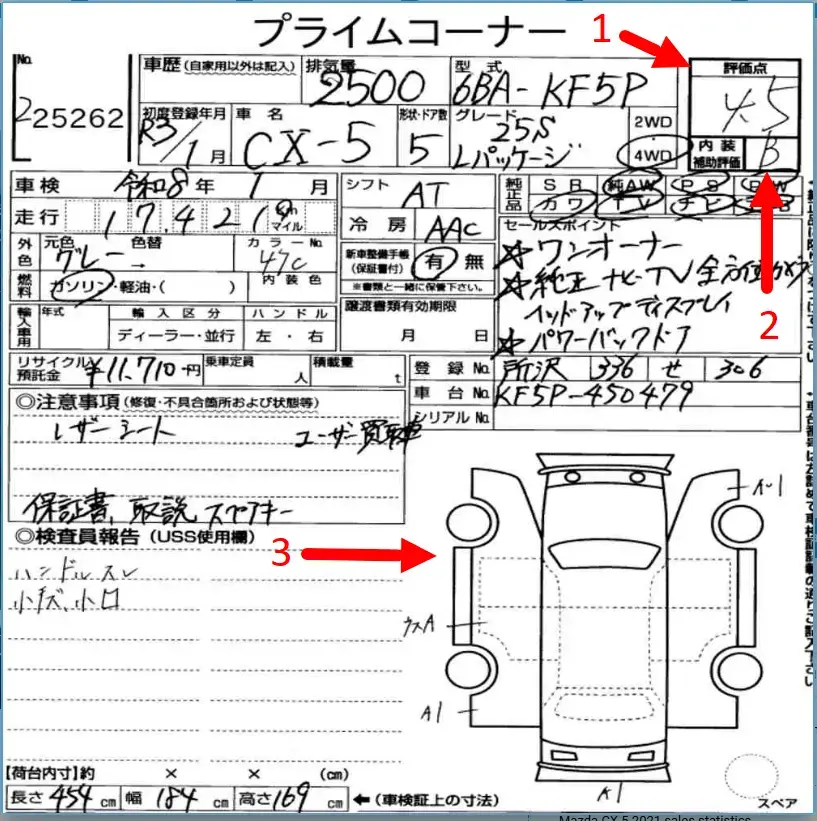
The overall grade
At the top of the sheet is a single letter or number — the auction house's overall condition grade:
- S — Nearly new, virtually flawless
- 6 / 5 — Excellent, no repairs needed, low mileage
- 4.5 / 4 — Good, minor or no repairs needed
- 3.5 / 3 — Average, higher mileage or repairs required
- 2 — Poor condition
- 1 — Heavily modified or affected — flood, salt, or hail damage
- R / RA — Accident-repaired (RA indicates a higher-quality repair)
- RA1 — Accident, not repaired — sold for parts or recycling
We generally source in the 4 to 6 range unless a client specifically asks otherwise — and if a lower grade ever comes up as an option, your manager will walk you through exactly what that grade means for that particular car before you consider bidding.
The diagram
Below the grade sits a simple line drawing of the car from above, with short codes marked around the body:
- A — Scratch
- U — Dent
- W — Wave or distortion in the panel
- X — Replacement required
- XX — Part already replaced
- C — Crack or chip
- B — Burn mark
- R — Rust
None of these automatically disqualify a car — a 15-year-old JDM classic with a couple of small "A" marks is completely normal. What matters is whether the marks add up to something structural, or whether they're purely cosmetic history.
Interior and exterior grade
A separate letter grades the interior and exterior condition:
- A — Very good
- B — Minor scratches, dents, or light interior wear
- C / D / E — Average to poor — stains, rust, burns, or heavy wear
This matters more than people expect, especially for cars that will spend years as a daily driver rather than a garage piece.
Why this matters to you
We don't just glance at the headline grade and place a bid. Every sheet we review gets translated in full — through AI translation plus a manager's read — and if anything in the diagram or the notes raises a question, we flag it before you decide whether to bid. When we send you a car for approval, you're seeing our read of the same sheet, in plain language, alongside the option to open the full sheet yourself.
If you ever want to see a real auction sheet we've pulled for a client, ask your manager — we're happy to walk through one together.